Three days before he was brutally killed in Vitomirica, Peja, Arlinda Silla Zekiaj had faced another serious situation in the house where he lived. Her former husband had refused to open the door even in the presence of the police, while the prosecution had assessed that her security was priority and that it was not safe to stay in that house.
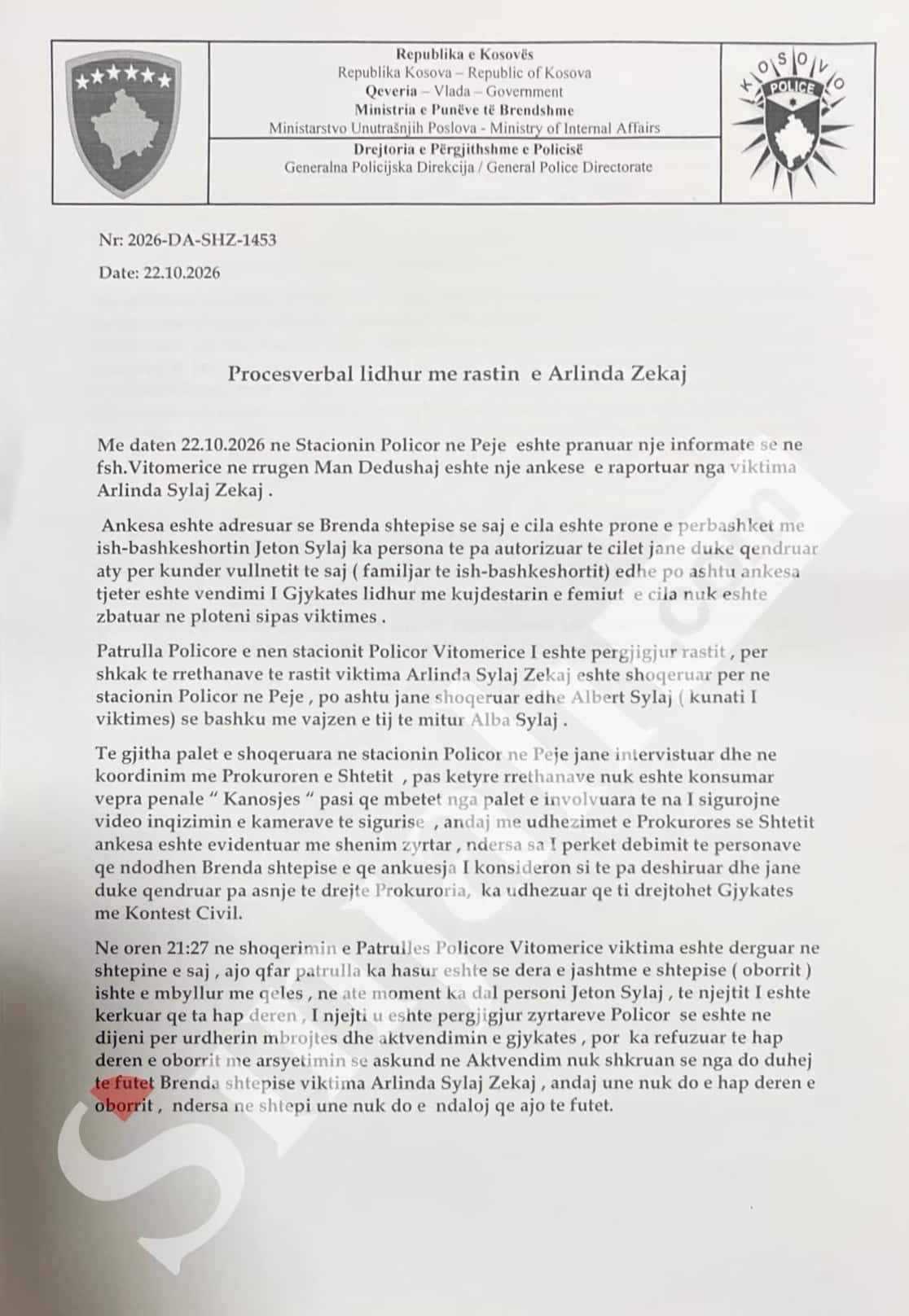
The signal paper has exclusively secured an official Kosovo Police process of October 22nd 2026, which reveals new circumstances of institutional treatment of the Arlinda case, just three days before it was found killed in the bedroom.

Document, identified with 202 6 – DA-SH-SHZ-1453 describes police intervention at home on the Man Dedushaj street in Vitomirica, where the victim had reported that unauthorised, family members of the former husband were standing on joint property.
In her complaint, Arlinda had also raised the issue of a judicial decision concerning the child’s custody, which, according to her, had not yet been implemented.
But what the record reveals is even more disturbing.
On the evening of October 22, about 21:27, the police had accompanied Arlinda to her home. The gate was closed, while the former husband, Sylaj, refused to open it.
According to the description in the document, Jeton Sylaj had rejected the opening of the door, arguing that in the judicial decision it was not determined that he should open it to his former spouse.
The record describes him as claiming that he would not stop the victim from entering the house but would not open the door himself.
This situation had brought another intervention and consultation with the State Prosecutor.
The official document states that, after assessing the circumstances, Arlinda’s security was considered prime and was estimated not to be certain that she would stay in that house.
The report says that because of the presence of family members of the former husband and the situation created, the prosecution had directed Arlinda to go to her brothers.
According to the document, the brothers had even appeared at the Péja Police Station and had expressed readiness to take their sister to their home.
Following communications in the presence of investigators and police officials, Arlinda had left for the brothers’ home that evening in the village of Radac, Pec.
Thus, on October 22, the institutions had documented a situation in which her stay at home was assessed as uncertain.
Just three days later, on October 25, Arlinda would experience the last night of her life.
That evening, she had been sent back to the Police Station in Pec, where she was interviewed about a case of domestic violence.
By 20:58, the police patrol had returned him to his home in Vitomirica.
About ten minutes after the patrol was removed, police had received information about the murder.
Arlinda had been found with no signs of life in the bedroom, while, according to initial doubts, her brother – in – law, Albert Sylaj, had hit her with ax on her head.
The October 22nd session raises an essential question: What had changed within three days that Arlinda, whose safety had been deemed endangered in that house, returned to the evening of his death?
Was it a new assessment of the danger? Were those whose presence she had filed a complaint removed? Had the application of the judicial order and the protection measures been verified? Who had confidently assessed her return?
The answers to these questions do not arise from the October 22nd report and require verification of the actions that institutions took during the last three days of her life.
Meanwhile, on the same date, October 22nd, Arlinda had delivered an urgent letter to the Constitutional Prosecutor in Pec, through which she sought institutional intervention and execution of a judicial order.
This is my last addition, she wrote, expressing fear that institutions could be forced to account only after life was taken.
Three days later, her fear of life ended in tragedy.
The document provided by the signal does not automatically prove the criminal or disciplinary responsibility of any official. However, he records that authorities had been informed of concrete danger circumstances and that on October 22nd the decision had been made to stay with her family rather than return home.
In Arlinda’s case, the question is not just who took his life. A equally important question about institutional investigation is how the risk that was documented before it was killed was addressed.
The signal paper will seek clarification from institutions responsible for the risk assessment, execution of judicial decisions and circumstances of the victim’s return home on the evening of October 25th.
Source Layer: Signal