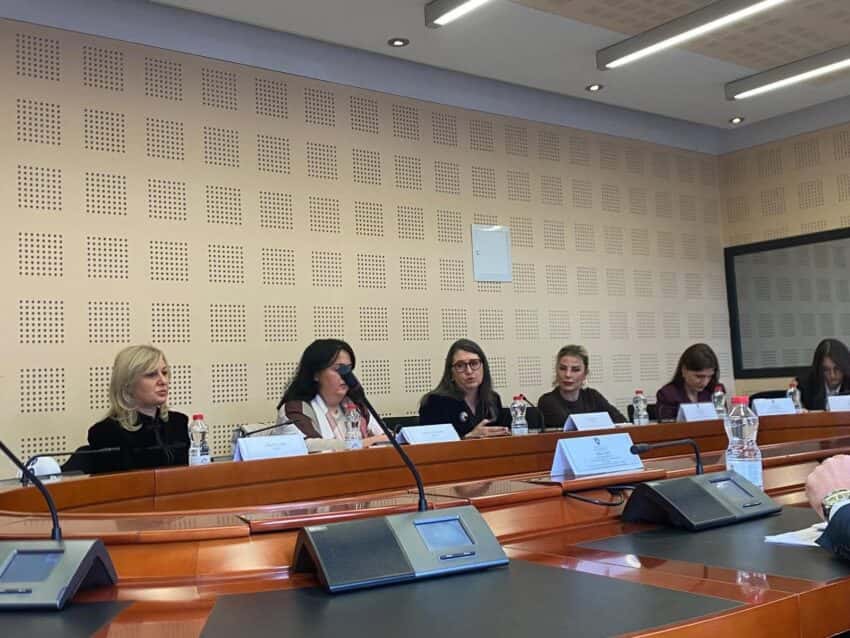
Executive chief of the Agency for Gender Equality ( ABR), Edi Gusia, during reporting to the Commission for Human Rights, Gender Equality and Petitions, has spoken of the institution’s competencies in dealing with domestic violence cases, legal measures for the protection of women and the responsibilities of institutions, following the assassination of Arlinda Zeqiaj. She has stressed that co-ordinating mechanisms at the local level are not functioning properly and that their meetings are almost existent.
Speaking to the commission members, the ABR executive chief has clarified that the institution it heads has no legal mandate to address directly individual cases of domestic violence or discrimination, stressing that institutional responsibilities are divided by law.

I’m going to share here with you, so today you need to get the agency’s opinion on this matter, even though we have to clear it up, the Agency for Gender Equality, under the Law on Gender Equality, there is no mandate to deal with cases, whether domestic violence or cases of discrimination. So, the legal framework of the Republic of Kosovo has very clear mandates regarding gender equality. It’s the commission in the Assembly, it’s the agency as executive, policy-harning and monitoring agency, and it’s the ombudsman institution, which deals with gender-based discrimination cases. It means, the powers are very separate, they’re very well divided, she said.
The ABR executive chief has cited the institution’s work in drafting the legal framework for protection from domestic violence, stressing that the agency has drafted the first law on the issue in 2010, as well as standard action procedures for handling cases.
As for the commitment of the Agency for Gender Equality in general in drafting the legal framework, it is noteworthy that the agency drafted the first law on protection from domestic violence in 2010, when, say, perhaps none of the Western Balkan states had any law on protection from domestic violence. We are projectors of standard action procedures to deal with domestic violence cases, where we describe the duties and responsibilities of the entire institutional chain. Those procedures are still in effect. This year we have reviewed these procedures and remain to be approved by the National Co-ordinator, the Ministry of Justice, Gusia has declared.
It has also recalled that in 2013, The ABG had proposed to the Government the establishment of the National Co-ordinator’s mechanism, in order to strengthen institutional co-ordination for handling issues related to gender equality and violence against women.
It is noted that in 2013 it was the Agency for Gender Equality that proposed to the Government the establishment of a mechanism such as the National Co-ordinator or coordinator, and that we insisted that this task be given to a person with a political mandate, since the Agency for Gender Equality, with the Law on Gender Equality, is guided by the civil service. It means, the agency’s title is a civil servant who responds directly to the prime minister. It’s a kind of, say, the independent institution, recommended by the 1995 Beijing Platform, which insists that we have such an independent mechanism, but that counts one in four compared to politics, the ABR executive chief said.
Speaking of inter-institutional co-operation, she has said the ABG has been working closely with the Ministry of Justice in reviewing legislation on protection from domestic violence, violence against women and gender-based violence.
As shallow as it is, we’ve been working very closely with the Ministry of Justice in reviewing the Law on Protection From Family Violence, Violence Against Women and Violence at Gender Base. And among these years we’ve been co-operating and cooperating with the Ministry of Justice in drafting the entire legal framework and sublegal acts in dealing with domestic violence cases. Significantly, the Ministry of Justice, in the past four years, has amended, completed, changed, and drafted 22 acts of norms, laws, sublaw acts and regulations concerning dealing with domestic violence and violence against women, it has stated.
The chief executive chief has also talked about Kosovo Police training in dealing with cases of domestic violence, saying the agency has trained about 11,000 and 300 police officers since the introduction of standard action procedures in 2013.
However, it has stressed that the agency’s limited human capacities make it difficult to expand these trainings.
Now, if we specifically return to the agency’s mandate, I said, over the years we train the police of the Republic of Kosovo as long as we have capacities. The Agency Legissation Division, which leads you to these trainings, has a minimum staff of just three people, which over the years has not increased. And if we see them, from the entry into force of standard action procedures in 2013, the Agency for Gender Equality has trained around 11 thousand and 300 policemen in the Republic of Kosovo. That’s not enough, but I’m still saying, with the number of staff we have available, these are the agency’s capacities, she said.
It has also highlighted the responsibilities of municipalities for the functioning of co-ordination mechanisms, which must gather institutions responsible for discussing cases of violence against women.
On the other hand, we have also trained co-ordination mechanisms at the local level, because all municipalities in the Republic of Kosovo have the responsibility to establish the co-ordination mechanism based on the regulation the Ministry of Justice has drafted, and the chairman of the co-ordination mechanism is the mayor of the municipality. I’m just stopping by to bring your attention to why this co-ordination mechanism is important, because there’s an obligation that at least three times a year, every mayor in the municipality to invite the director of the QPS, the director of health, the director of police station, the fundamental court and the prosecutor, the victims’ defenders, free legal assistance in the municipality in which he or she leads, and to be informed exactly about all cases of violence against women in its municipality. These cases have been ignored. If you as a parliamentary commission address 38 mayors how many times they’ve invited the co-ordination mechanism, you’ll see that the meetings are almost existing, she said.
It has spoken of financing housing for victims of violence, saying the Ministry of Labour and Social Management has earmarked 1.5m euros for ten accommodations in Kosovo. According to her, even municipalities have an obligation to contribute to their financing.
On the other hand, shelters have stable financing. It means, the Ministry of Labour and Social Management has allocated 1.5m euros for the ten shelters of the Republic of Kosovo, one of which is housing for trafficking with human beings, which the Government leads, while the other nine are civil society organisations. Yes, on the other hand, municipalities have the responsibility to finance. Normally, it is impossible for 38 municipalities to each have a shelter because there are no budgetary means, but municipalities are obliged to finance housing in which, i.e., the region’s victims are sheltered. Do all municipalities do that? No. Someone’s funding, someone doesn’t finance, but that’s beyond our competence. This is a question that probably had to be solved through the Ministry of Local Power and see what those municipalities are that didn’t finance housing, she said further. /EO
Source Layer: Dukeagini